Why Overcoming Passkey Adoption Blockers is an Organizational Team Sport
Phishing resistant authentication is a standards-based approach to verifying identity using public key cryptography instead of shared secrets like passwords. Methods such as FIDO2 and passkeys prevent credential replay and phishing by cryptographically binding authentication to legitimate services.
Deploying phishing-resistant MFA is no longer a luxury; it’s an operational necessity. Yet, even when security teams recognize the immense value of FIDO2 passkeys, moving a project from the planning phase to a full organizational rollout often triggers unexpected friction.
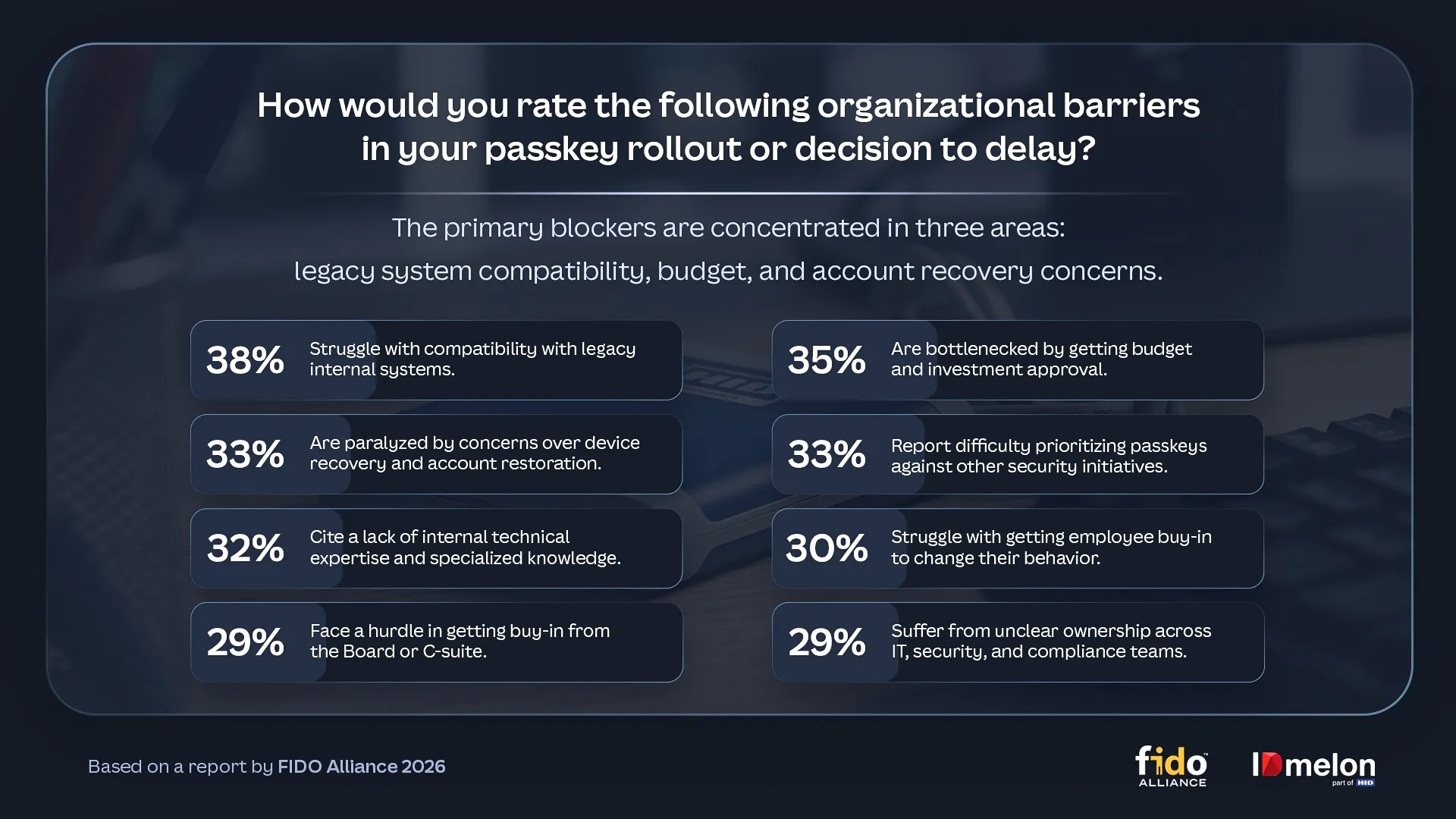
According to the FIDO Alliance State of Passkeys Report, the obstacles to passkey adoption go beyond user pushback. Organizations face structural, financial, and technical hurdles. When asked to what extent various organizational barriers impact their passkey rollout or their decision to delay, security leaders pointed to a complex web of architectural and operational challenges as follows:
If your organization is stuck trying to navigate these exact issues, you aren't alone. Many security paths stall right at the intersection of modern compliance mandates and decades of accumulated technical debt. Fortunately, you don't have to let these challenges paralyze your security roadmap.
Here is a deep dive into how IDmelon, now part of HID, supports enterprise adoption of standards based, phishing resistant authentication by addressing common organizational and operational blockers.
Hurdle 1: The Legacy Trap (38%)
The Problem: Many enterprises aren't operating on purely modern, cloud-native architectures. They rely on deep-rooted legacy internal systems, older desktop operating systems, thick-client architectures, and on-prem applications that simply do not natively support modern WebAuthn or FIDO2 protocols. When confronted with the prospect of rewriting legacy application code or refactoring entire identity stacks just to fit new security standards, organizations hit a multi-million-dollar wall.
The Solution: You shouldn't have to rebuild your entire infrastructure just to secure it. Within a standards based authentication architecture, IDmelon provides an orchestration layer that helps enterprises apply FIDO2 and passkeys across existing credentials and environments. Our orchestration platform bridges the gap between modern FIDO2 protocols and legacy enterprise endpoints. By turning your existing building access badges or smartphones into secure enterprise credentials, we abstract the underlying authentication layer. This allows you to deploy state-of-the-art passwordless authentication across legacy workstations, virtual desktop infrastructures (VDI like Citrix or VMware), and local environments, without altering a single line of your legacy application code.
Hurdle 2: The Budget Bottleneck (35%)
The Problem: Security budgets are tighter than ever, and prioritizing initiatives is a constant financial battle. Buying standalone, proprietary hardware security keys for thousands of employees represents a massive upfront capital expenditure (CapEx). Beyond the initial purchase price, the Total Cost of Ownership (TCO) skyrockets once you account for the logistical overhead of provisioning, shipping hardware keys to remote workers, and maintaining a constant surplus inventory to replace a percentage of hardware keys that are lost or broken annually. Furthermore, passwordless rollouts often force organizations to adopt heavy, centralized Identity Provider (IdP) or IAM architectures. In large-scale projects, routing every single user login through a secondary identity layer before hitting applications requires scaling up massive, expensive data center infrastructure just to handle the traffic.
The Solution: By enabling organizations to reuse existing enterprise credentials—such as physical access badges or managed smartphones—IDmelon helps reduce the need for incremental hardware purchases when deploying phishing resistant authentication. This approach can shift passkey adoption from a large, upfront capital investment to a more predictable operational expense aligned with existing infrastructure.
But the savings go deeper than hardware. Because IDmelon acts as a lightweight orchestration layer rather than a heavy, hardware-bound IAM system, there is no need to scale up a massive backend data center infrastructure to route traffic. If your employees carry an NFC/RFID badge to open office doors, for example, or if they have a smartphone in their pocket, you already own your security keys. IDmelon simply repurposes these existing physical assets into trusted FIDO2 credentials. By doing so, you eliminate procurement cycles, zero out unnecessary shipping logistics, and completely bypass the hardware replacement loop, turning a high-CapEx roadblock into a highly predictable, cost-effective operational expense (OpEx).
Hurdle 3: The Recovery Anxiety (33%)
The Problem: IT admins lose sleep over account recovery. If an employee leaves their passkey-bound device at home, breaks their phone, or misplaces their card over the weekend, how do they get back into their workstation securely? Traditional recovery methods are a primary target for hackers; malicious actors routinely exploit weak helpdesk verification loops via social engineering. If recovery is too loose, your security is broken. If it is too rigid, employee downtime disrupts operations and overwhelms helpdesk personnel.
The Solution: Accountability and resilience shouldn't come at the cost of security. IDmelon features a centralized orchestration platform built specifically to handle the entire lifecycle of credentials. When an asset is lost, IT can instantly revoke access from a single central dashboard, rendering the lost badge or device completely useless to an unauthorized finder. Simultaneously, administrators can securely provision a temporary backup credential or transition access to a secondary device in seconds. This cloud-managed recovery workflow ensures that zero-trust boundaries are maintained without causing operational paralysis.
The Remaining Bottlenecks
While legacy, budget, and recovery represent the top three hurdles, true enterprise-wide deployment requires addressing the downstream operational roadblocks highlighted in the report:
Prioritization and Internal Expertise (33% and 32%): Security roadmaps are packed with competing priorities like cloud migrations and network visibility. Because manual FIDO2 implementations demand deep, specialized cryptographic expertise, passkey rollouts often get pushed to the back burner. IDmelon reduces the operational complexity of deploying phishing resistant authentication by providing a management and orchestration layer that abstracts protocol level details. This allows general IT teams to support passkey based authentication without requiring deep cryptographic expertise, while still relying on established standards like FIDO2.
The Change Management Puzzle (30%): Modifying human behavior is notoriously difficult. Forcing workers to change how they log in generates immediate friction. IDmelon side-steps the behavioral battleground completely. Because workers are already accustomed to tapping their badge to enter a door or using facial recognition to unlock their personal phone, we introduce zero new concepts; it simply applies their existing habits to their workstation login.
C-Suite Buy-In and Unclear Ownership (29% and 29%): Boards want compliance without downtime; C-suite executives want immediate ROI; and compliance teams need clear auditing lines. IDmelon supports enterprise efforts to meet phishing resistant authentication requirements aligned with frameworks such as CMMC 2.0, HIPAA, and CJIS by providing centralized visibility and audit friendly credential lifecycle controls. By avoiding infrastructural disruptions and lowering helpdesk dependencies, the business case becomes an undeniable win for the executive leadership.
The budget blocker (35%) isn’t just about money; it’s about organizational complexity. Here’s why getting approval for passkeys is not easy, and how IDmelon aligns with every stakeholder group.
Why Passkey Buy-In is an Organizational Team Sport
Securing budget and approval for a security initiative is rarely a single-step process. According to the data, those facing budget or C-suite barriers have to navigate a sprawling corporate matrix. Approval and buy-in must span multiple distinct stakeholders across the organization as follows:
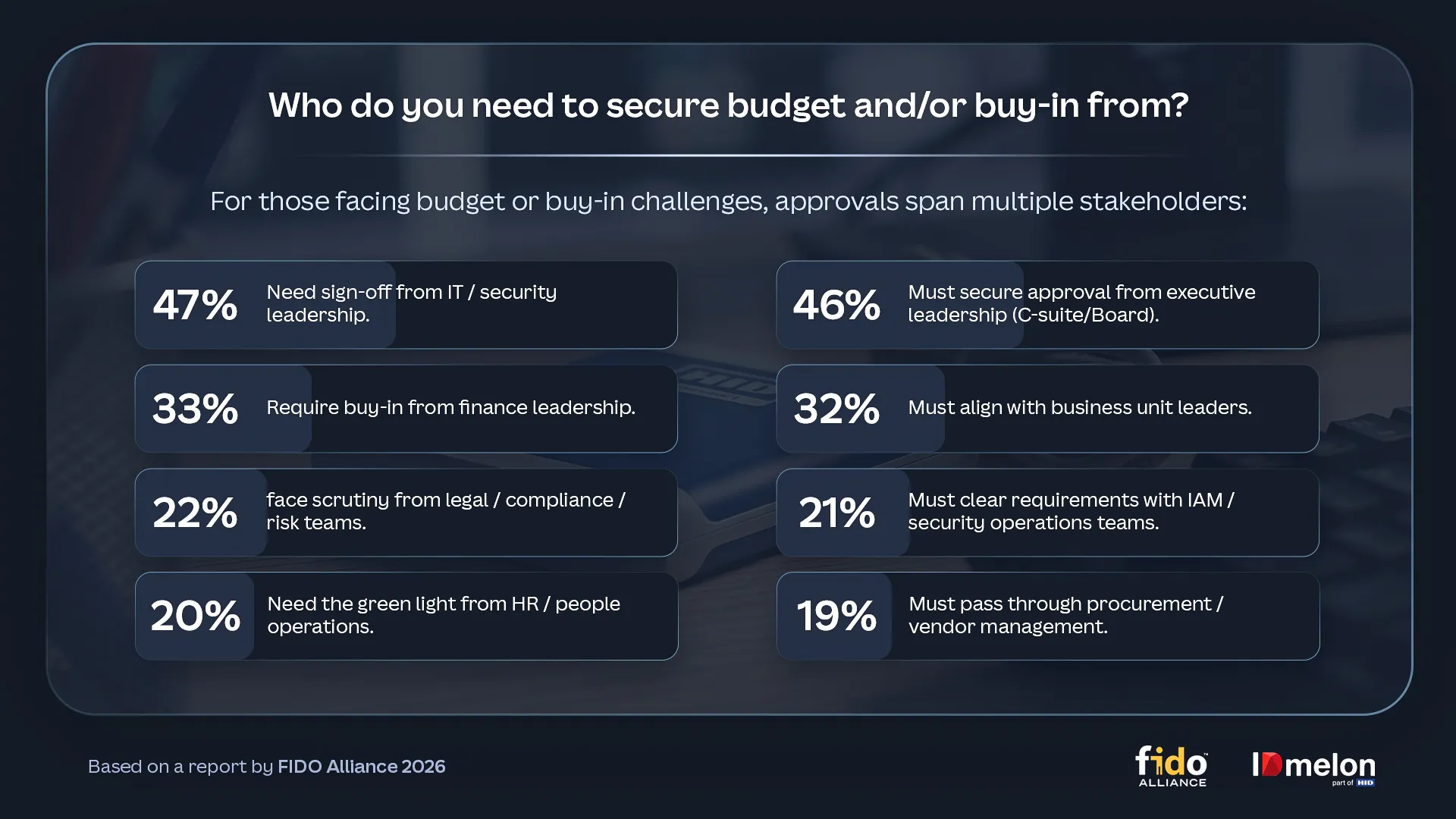
This illustrates why traditional passkey implementations stall. They look great to security teams but present logistical, financial, or operational challenges to everyone else. IDmelon solves this by offering a rare “win-win” alignment across all 8 stakeholder groups:
For IT, IAM, & SecOps (47% & 21%): We deliver a plug-and-play FIDO2 deployment that plugs straight into existing identity infrastructures without demanding specialized cryptographic engineering expertise.
For Executive & Finance Leadership (46% & 33%): By eliminating the need to purchase separate physical tokens, we remove massive CapEx hardware procurement lines from the budget, demonstrating immediate ROI.
For Business Units & HR (23% & 20%): Because IDmelon utilizes existing habits (like tapping a badge or using phone biometrics), it introduces zero user friction and demands no formal technical training, protecting daily operational productivity.
For Legal & Compliance (22%): The platform enforces true, phishing-resistant standards that satisfy rigid regulatory frameworks out of the box.
For Procurement (19%): It bypasses complex vendor vetting, ongoing supply chain delays, and hardware storage logistics.
Don’t let legacy tech, budget hurdles, or change-management fears stall your path to a secure, passwordless future.
👉 Contact our team today to see a live demo of how HID and IDmelon transform your existing infrastructure into a phishing-resistant fortress.
Frequently Asked Questions About Passkey Adoption (FAQ)
Q1: Can IDmelon handle hybrid environments with both remote and on-prem frontline workers?
Yes. Because IDmelon can utilize smartphones for remote employees and existing physical ID badges for on-prem frontline workers, it provides a unified management experience across completely different working environments.
Q2: How does leveraging existing infrastructure help with compliance audits?
IDmelon is designed to support phishing resistant MFA requirements by enforcing FIDO2 based authentication and SOC2 compliance and integrating with existing IAM (Identity and Access Management) systems.
Q3: What is the onboarding time for a company dealing with legacy systems?
Because IDmelon requires no complex hardware overhauls or changes to your legacy code, deployment can scale across an enterprise in hours or days rather than months, instantly bypassing the typical technical resource bottlenecks.
Q4: How does IDmelon protect user privacy on personal BYOD smartphones?
A: IDmelon operates on a zero-trust architecture. The platform never gains access to personal data, text messages, photos, or personal biometrics stored on the user's smartphone. It strictly manages the enterprise security token, completely separating corporate security from personal privacy.
Q5: What happens if our building access badges are based on older RFID/NFC protocols?
IDmelon’s flexible ecosystem supports an array of proximity card technologies. Our compatibility layer allows you to leverage your existing badge deployment without forcing an expensive corporate-wide badge re-issuance project.
Suggested Posts to Read
FIDO Keys: Phishing-Resistant Authentication Without Friction

FIDO Keys: Phishing-Resistant Authentication Without Friction

Why Criminal Justice Information Services (CJIS) Compliance Matters and How IDmelon Helps Meet Authentication Requirements
Why Criminal Justice Information Services (CJIS) Compliance Matters and How IDmelon Helps Meet Authentication Requirements
IDmelon Achieves SOC 2® Attestation: Our Continued Commitment to Enterprise‑Grade Data Security