FIDO Keys: Phishing-Resistant Authentication Without Friction
Cybersecurity has long followed a cynical law: the safer you want to be, the more annoyed you’re going to get. For years, we’ve lived this reality through complex passwords, SMS codes, and authenticator apps. But FIDO (Fast IDentity Online) is finally rewriting the script.
As we move through 2026, the question is no longer whether to adopt FIDO, but how. The latest innovations from industry leaders like HID and its IDmelon division are proving that high-level security doesn't have to come at the cost of a smooth user experience. In fact, it can feel like an upgrade in every sense.
Who’s this for, really? The IT director tired of password-reset tickets. The remote worker who’s memorized 14 variations of “Spring2026!” The CFO watching phishing payouts climb. And yes, the regular human who just wants to tap their phone and get back to their day. FIDO isn’t a feature; it’s a friction killer for everyone with a login—and a foundational upgrade for enterprise authentication strategies focused on phishing resistance, passwordless access, and converged identity.
What is FIDO authentication?
FIDO authentication is a standards-based, phishing-resistant method of verifying user identity using public-key cryptography instead of shared secrets like passwords. FIDO2 authentication—built on WebAuthn and CTAP—enables passwordless and passkey-based login across devices, applications, and enterprise environments while preventing credential theft and phishing attacks.
The Security Fortress
Standard Two-Factor Authentication (2FA) is a great start, but it has a “weakest link” problem. If a hacker lures you to a fake login page, they can easily trick you into typing in your SMS code. FIDO keys solve this through the FIDO2 standard, which combines several key technical components:
- WebAuthn: A standard web API that allows browsers to communicate with authenticators. It uses public-key cryptography, meaning your private key never Public leaves the device. During login, the server sends a challenge, and your key signs it, verifying your identity without ever sharing a “secret.”
- CTAP2 (Client-to-Authenticator Protocol): This is the “language” the physical key speaks to your device via USB, NFC, or Bluetooth. It supports Resident Keys (discoverable credentials), which allow you to log in without even typing a username.
- Phishing Resistance: Because the credential is cryptographically bound to the specific domain (Origin-Bound), a FIDO key will refuse to authenticate on a fraudulent site, even if it looks identical to the real one. If the URL is fakebank.com instead of real-bank.com, the signature will not be valid. Authentication fails before you ever do. This is why FIDO2 is considered phishing-resistant authentication by design—not just multi-factor authentication layered on top of passwords, but a fundamentally different security model.
The Convenience Win: The "Tap-and-Go" Workflow
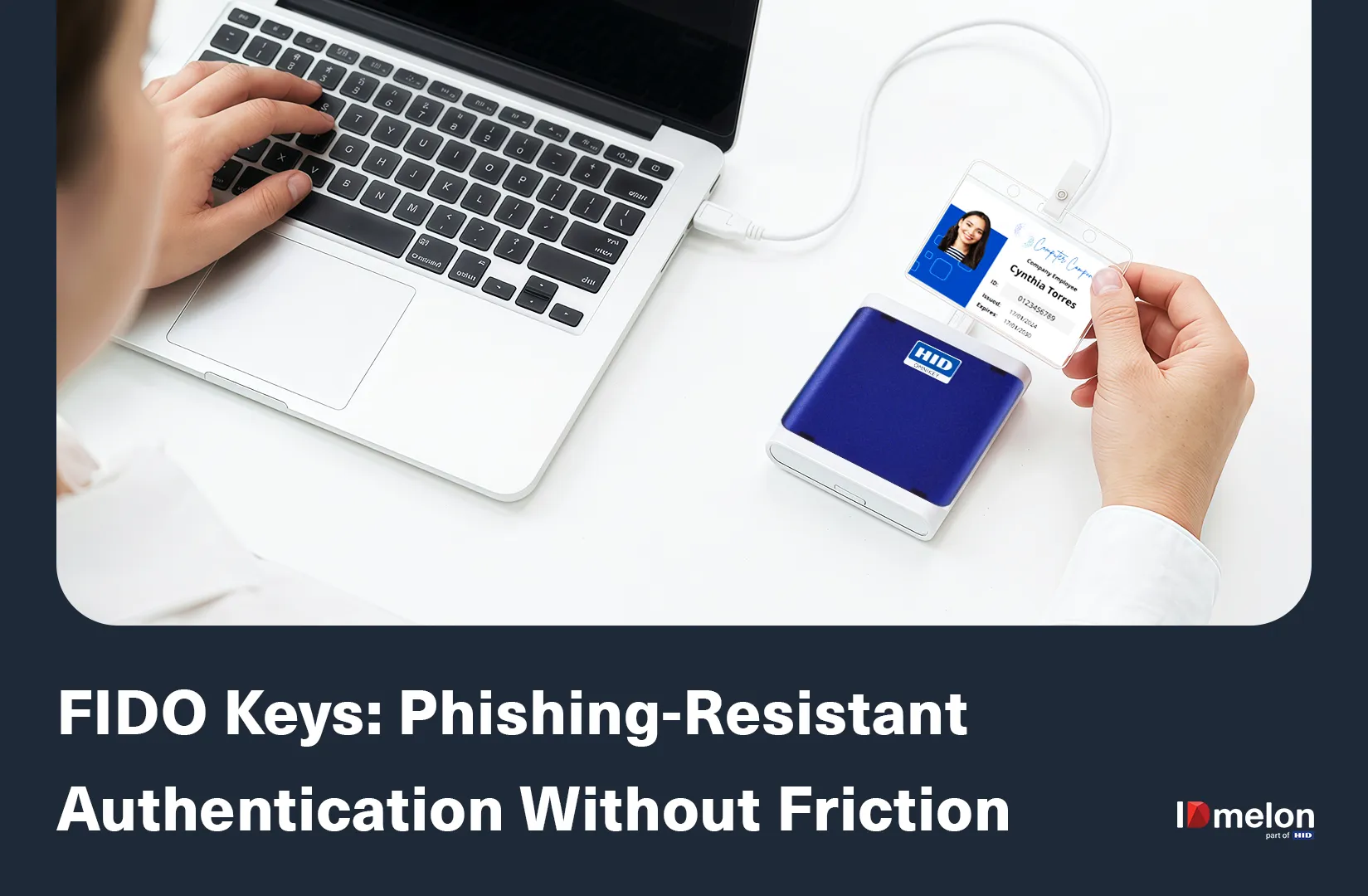
FIDO keys are the ultimate “quality of life” upgrade. Instead of unlocking your phone and racing against a 30-second timer on an app, you can simply touch a biometric scanner or tap your card or phone on a reader already plugged into your laptop.
Before FIDO: Type username. Type password. Mistype password. Reset password. Check SMS. Wait 20 seconds. Enter code. Expired. Request new code. Can’t? Ask IT teams to rest password. Finally in.
After FIDO: Tap your badge. Or unlock your phone. Or touch a key. That’s it. You’re in before your coffee cools. For IT teams, this shift reduces password resets, MFA fatigue, and support tickets—while improving login success rates for end users.
With the rise of Passkeys, we are entering an era where you can skip the password entirely. Your key handles the proof of who you are instantly, often paired with a simple PIN or biometric gesture to ensure it's really you.
HID and IDmelon: Converged Authentication for Physical and Digital Access
The conversation around FIDO has expanded beyond simple USB sticks. Recent innovations, most notably HID's acquisition of IDmelon in 2025, are effectively bridging the gap between physical building access and high-assurance digital security.
HID has long been the gold standard for physical access. With their Crescendo line, they’ve merged the traditional office badge with the modern digital login.
- Protocol Multi-Tasking: Modern HID credentials are built for versatility, supporting FIDO2, PKI, and OATH standards simultaneously on a single chip.
- One Credential for Doors, Devices, and Applications: Employees use a single high-security Seos® badge to tap into the office door, unlock their Windows workstation, and authenticate into cloud applications via FIDO2.
- Enterprise Management: Using HID's Credential Management System (CMS), companies can provision and revoke keys, ensuring high-security environments remain uncompromised even as personnel change.
IDmelon has revolutionized the market by answering the enterprise's most pressing question: “What if we want to reduce the cost of enhancing our security posture?”
- Orchestration Platform: IDmelon's technology allows organizations to turn existing identifiers, like a smartphone or a current NFC employee badge, into a fully managed FIDO2 security key, instantly and at scale.
- Smartphone as a FIDO Key: Through the IDmelon Authenticator app, your phone acts as a “roaming authenticator.” When you try to log in to your PC, your phone receives a secure prompt (often leveraging local biometrics) to verify the request.
- ID Badge as a FIDO Key: Even legacy physical cards can be converted into modern FIDO tokens without a massive hardware overhaul. This provides a familiar, frictionless experience that mirrors physical door access but applies it to the digital domain.
- Biometrics as a FIDO Key: Native biometric sensors (fingerprint or facial recognition) can also be used as a FIDO2 credential. This allows users to authenticate using their own unique biological traits, replacing hardware with a secure, “always-on” identity factor.
Here is an example:
An employee taps their existing NFC badge to enter the office. Later, at their laptop, the same badge, now FIDO2-enabled via IDmelon’s orchestration platform, unlocks Salesforce, Okta, and Slack. No new hardware. No training. Just a single tap for doors and data. That’s what we mean when we talk about convergence!
But What About…?
…if I lose my key?
Fair question. Unlike a lost phone with saved passwords, a lost FIDO key is useless without your PIN or biometric. And with IDmelon management panel, IT can revoke it remotely before you finish filing the lost-and-found report.
…if a site doesn’t support FIDO yet?
Then you’re in the minority. Every major browser, OS, and platform (Google, Microsoft, Apple, GitHub, PayPal) now speaks FIDO2.
…if we already have badges and phones?
Perfect. That’s exactly the point. You don’t need to reissue new pieces of hardware. You just need to unlock the hidden potential of your existing infrastructure.
The Verdict: A Seamless Evolution
For years, security meant choosing between safe and smooth. FIDO, especially with HID and IDmelon, kills that trade-off. You don’t need a hardware refresh. You don’t need users to learn new rituals. You just need to unlock the FIDO potential already sitting in your employees’ hands.
Passkeys with HID and IDmelon in its portfolio represent a rare “win-win” in tech: an upgrade that makes you significantly safer while making your daily digital life noticeably smoother. Whether you’re using a dedicated hardware key, a converged HID badge, or turning your phone or card into a security powerhouse with IDmelon, the message is clear: The password era isn’t ending. It’s over. You just haven’t tapped into it yet.
Frequently Asked Questions About FIDO Keys and Passkeys
How are FIDO keys used in HID and IDmelon enterprise deployments?
In HID and IDmelon deployments, FIDO keys are used as part of a managed enterprise authentication strategy—often leveraging existing badges, smartphones, or biometric devices rather than issuing new hardware. IDmelon orchestrates these authenticators, while HID credentials provide secure, standards-based authentication across physical and digital environments.
How do HID badges support FIDO-based authentication?
HID smart credentials, such as Crescendo cards, can support FIDO-based authentication alongside physical access technologies. This allows a single badge to authenticate users at building entry points, workstations, and enterprise applications using passwordless, phishing-resistant methods.
What role does IDmelon play in FIDO authentication?
IDmelon acts as an orchestration layer that enables organizations to turn existing identifiers—such as smartphones, badges, or biometrics—into managed FIDO authenticators. This allows enterprises to scale passwordless authentication without replacing their current credential infrastructure.
Can enterprises enable FIDO authentication without issuing new hardware?
Yes. With HID, organizations can enable FIDO-based authentication using devices and credentials employees already have, such as NFC badges or smartphones. This reduces deployment cost while accelerating adoption of passwordless authentication.
How does converged physical and digital access improve security?
Converging physical and digital access under a single identity reduces credential sprawl and simplifies policy enforcement. For enterprises, this improves visibility, reduces administrative overhead, and ensures consistent authentication controls across doors, devices, and applications.
What happens if an employee loses a badge or device used for FIDO authentication?
In enterprise deployments, FIDO credentials tied to a lost badge or device can be revoked through centralized management. Because authentication also requires a PIN or biometric, a lost credential alone does not grant access.
Why is FIDO considered phishing-resistant in enterprise environments?
FIDO authentication is phishing-resistant because credentials are cryptographically bound to legitimate services and cannot be reused on fraudulent sites. In enterprise environments, this helps reduce account compromise even when users are targeted by sophisticated phishing attacks.
Suggested Posts to Read

IDmelon Leads the Passwordless Way with First Passkey Management Support on Android

IDmelon Leads the Passwordless Way with First Passkey Management Support on Android

The Future of Healthcare Security: Going Passwordless with Passkeys
The Future of Healthcare Security: Going Passwordless with Passkeys

Why is Authentication Important in Healthcare, and What is the Best Solution?