Overcoming the 94% User Resistance: How Empathetic UX Drives Passkey Adoption
Passkeys are no longer an experimental technology. According to the FIDO Alliance State of Passkeys 2026 report, 68% of organizations are actively deploying passkeys for workforce sign-ins. Yet many enterprises are discovering that making passkeys available does not guarantee they will be adopted.
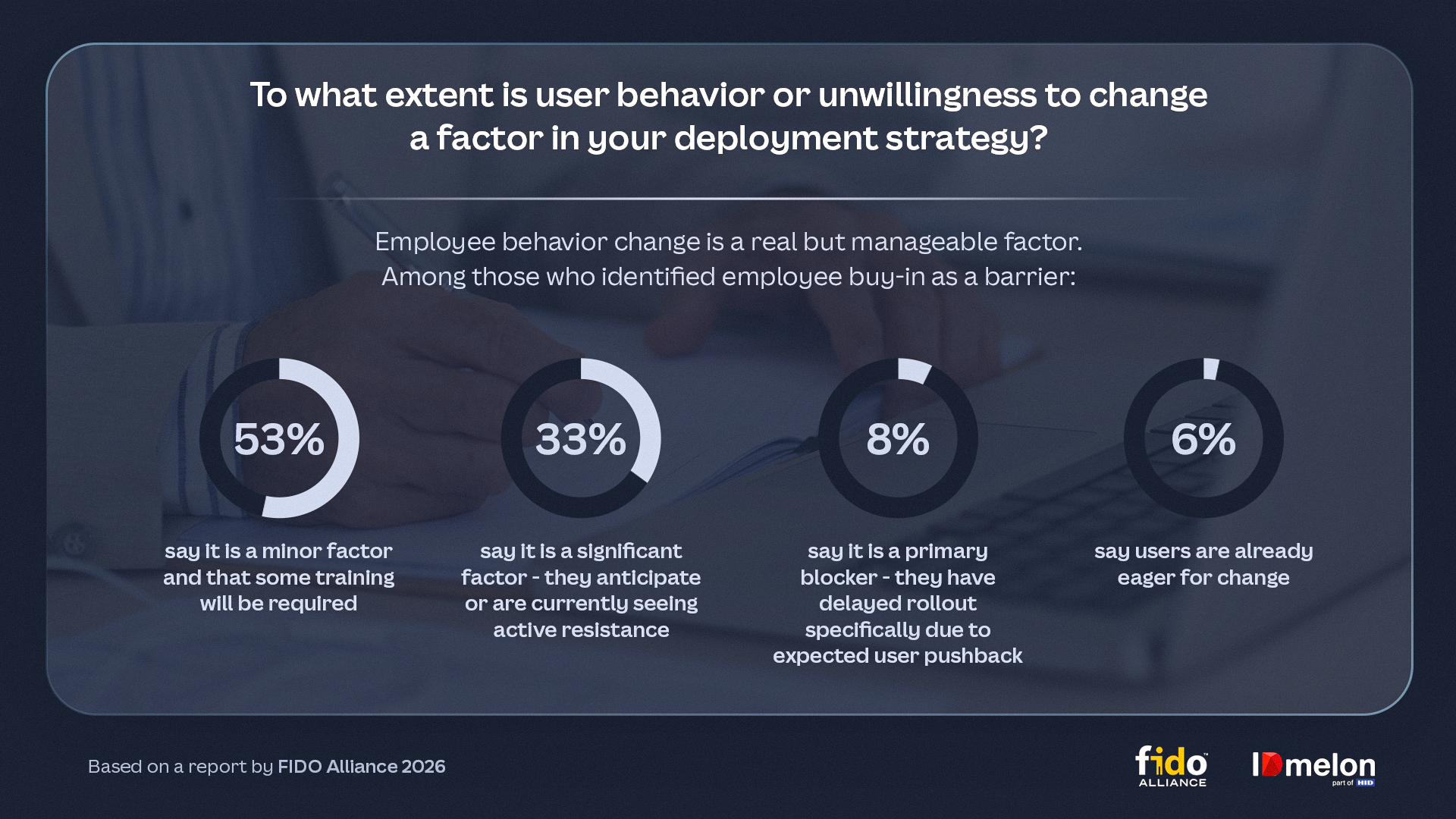
Nearly one in ten organizations has delayed a security rollout entirely due to anticipated or active employee pushback. When asked to what extent user behavior or unwillingness to change affects deployment, 33% of organizations report active resistance, while 8% have paused deployments altogether. Most telling of all: 94% of employees are not eager for change.
The UX Gap: Why Employees Resist Passkeys
The passkey adoption gap is the disconnect between deploying passwordless authentication and achieving consistent, organization wide usage. This gap is most often caused by friction, workflow disruption, and user experiences that require employees to change how they work.
Resistance to passkeys is rarely about security skepticism. It is about friction.
Most failed security rollouts ask too much of employees. They introduce new workflows, unfamiliar hardware, or extra steps layered onto already demanding roles. In high pressure environments, even small delays create frustration, reduce productivity, and undermine trust in IT initiatives.
From a psychological perspective, every additional second added to a login process increases cognitive load. Over time, this friction leads to workarounds, shadow IT, or outright resistance. Empathy in cybersecurity means recognizing these realities and designing authentication around existing behavior — not forcing users to adapt to technology.
At IDmelon, now part of HID, we believe the most successful passkey deployments start with familiarity. Instead of asking employees to learn something new, organizations should leverage tools their workforce already uses every day.
Empathetic UX in authentication means meeting users where they are:
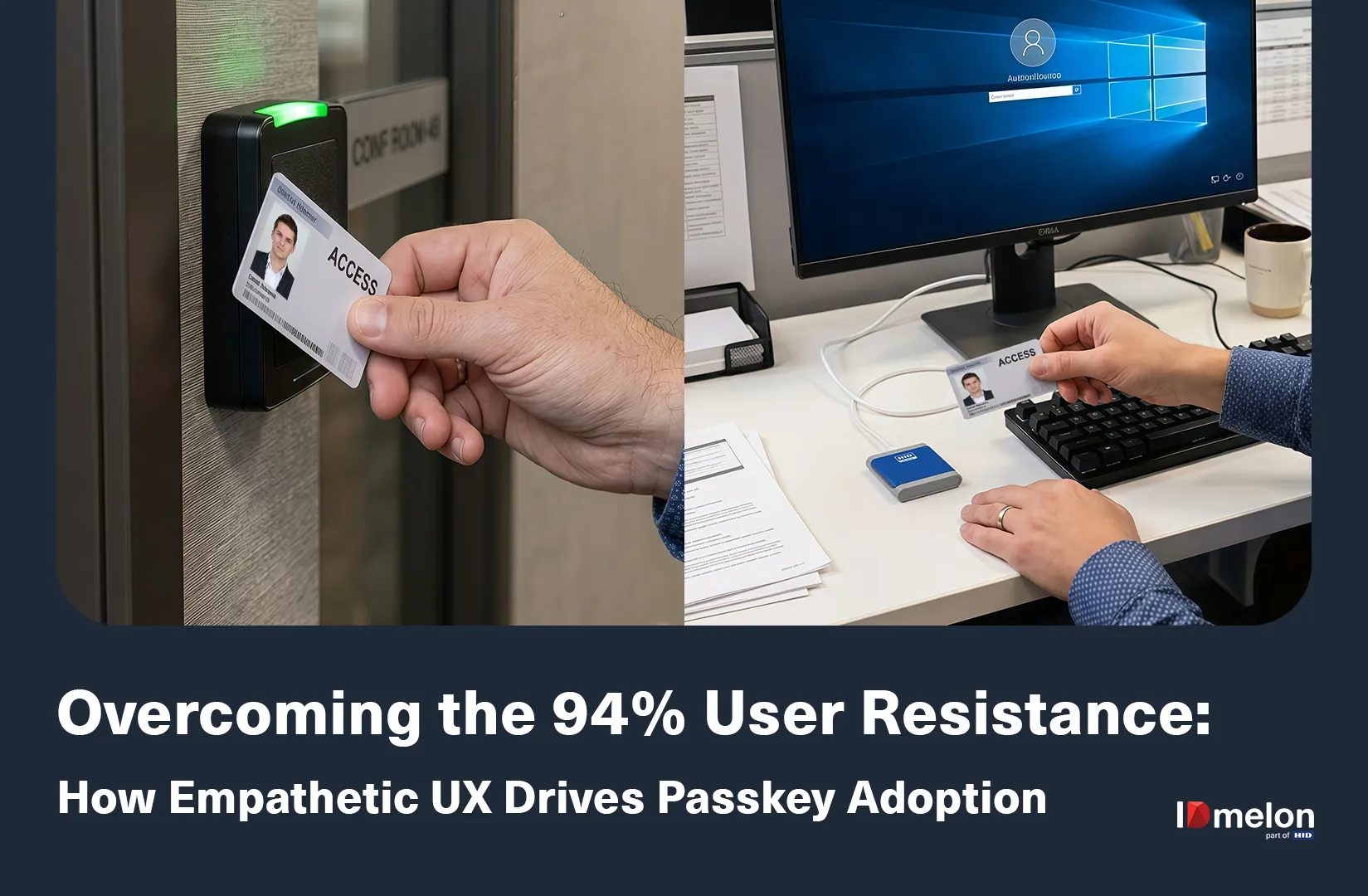
- Existing ID Badges: If employees already use an NFC or RFID badge to enter the building, that same badge can be used for phishing resistant, passwordless digital authentication. No new devices. No new habits.
- Smartphones: Employees already know how to use their phones. Turning smartphones into manageable FIDO2 security keys eliminates the learning curve while maintaining strong authentication assurance.
- Built-in Biometrics: Fingerprints and facial recognition are already part of daily life. By leveraging built in biometrics on laptops and mobile devices, organizations deliver enterprise grade security that feels natural and intuitive.
When authentication aligns with familiar behavior, it stops feeling like a task and becomes a habit. This is how organizations achieve something rare in IT: security adoption that employees barely notice.
At the same time, eliminating passwords removes one of the most common sources of helpdesk tickets — password resets — reducing operational costs while improving user satisfaction.
For enterprises looking to extend this experience across both physical and digital access, empathetic UX becomes a foundational component of a broader converged authentication strategy that unifies doors, devices, and applications under a single identity framework.
Industry-Specific Impact: Solving Real World Friction
While these challenges exist across the board, how they manifest depends entirely on the environment. In many of these sectors, frontline workers usually are not tech-savvy and have little patience for complex digital hurdles. With IDmelon, almost no training is required and there is no involvement from the end users to get started. Here is how leading with empathy transforms security in specific sectors:
Healthcare: Passwordless Authentication for Shared Clinical Workstaations
In a clinical setting, every second spent fighting a login prompt is a second taken away from patient care. Clinicians often move between shared workstations mobile devices while managing complex EMR/EHR records, for example. By turning existing ID badges into trusted credentials, doctors and nurses can access patient data with a simple tap, meeting security compliance while improving employee satisfaction with IT—without taking time away from care.
Manufacturing & Logistics: Phishing Resistant MFA Without Phones
On factory floors and warehouses, meeting CMMC 2.0 or NIST requirements for phishing-resistant MFA is often a logistical nightmare. Workers may not have personal phones, may not be allowed to use phones, or may be wearing gloves, making biometric or text-based codes impossible. Using proximity badges allows for “invisible” security that doesn't disrupt high-speed production lines or require workers to remove safety gear.
Banking & Financial Institutions: Phishing Resistant MFA for High-Value Transactions
In high-stakes branch environments, security is non-negotiable, but customer service must remain the priority. Bank tellers often switch between internal systems and shared terminals while the customer is waiting. By using the same badges used for vault or office access, for example, tellers can authenticate securely in a split second, preventing shoulder surfing and unauthorized access while maintaining a professional, efficient customer experience.
Law Enforcement: CJIS Compliant Passwordless Access
In public safety, emergency situations demand immediate, reliable access to sensitive data. Officers operating out of patrol cars must log into Mobile Data Computers (MDCs) to access criminal databases and dispatch info. Typing complex passwords while wearing tactical gear or in high-stress environments is a liability. Officers can unlock Windows PCs in under 5 seconds by tapping their agency ID, ensuring CJIS compliance and secure data access without hindering situational awareness.
Retail & Hospitality: Reducing Training and Turnover Costs
High employee turnover makes repeated security training expensive and ineffective. In fast paced retail and hospitality environments, staff must move quickly between POS systems, inventory tools, and guest management platforms. Familiar credentials — such as badges or wearables — eliminate forgotten passwords, reduce helpdesk load, and keep the focus on customer experience.
Education: Passwordless Access Across Diverse User Populations
Universities support a wide range of users, devices, and access needs. BYOD environments and seasonal onboarding create heavy IT support burdens. Leveraging the same ID cards already used for campus services provides a consistent, secure standard that protects academic data without constant troubleshooting.
Across industries, the pattern is consistent: when the secure path is also the easiest path, adoption follows naturally.
These are only some of the industries where a human-centric approach is proving that security doesn't have to be a battle. Whether in a lab, a classroom, or a squad car, the goal remains the same: making the right way the easy way.
Turning Resistance Into Invisible Adoption
Organizations do not need to fight human nature to deploy strong security. They need to design with it.
By combining empathetic UX with phishing resistant passkeys and enterprise grade authentication controls, organizations can move toward a fully passwordless future — without friction, resistance, or disruption.
Together, IDmelon and HID help organizations deploy passkeys that employees actually use, while supporting broader identity, access, and compliance strategies across physical and digital environments.
Ready to turn user resistance into seamless passkey adoption?
Reach out to our experts to discover how HID and IDmelon can make passwordless authentication feel like second nature for your workforce.
Suggested Posts to Read
Why Overcoming Passkey Adoption Blockers is an Organizational Team Sport

Why Overcoming Passkey Adoption Blockers is an Organizational Team Sport

Why is Authentication Important in Healthcare, and What is the Best Solution?
Why is Authentication Important in Healthcare, and What is the Best Solution?

The Future of Healthcare Security: Going Passwordless with Passkeys